AL Tracking - User guide
How to set up and use the app in Business Central.
1. Concepts in one minute
- Standard Business Central tracks Lot and Serial. AL Tracking adds three more dimensions: Package No. (the carton), Pallet No. (the SSCC) and External Lot No. (the supplier's lot/carton number).
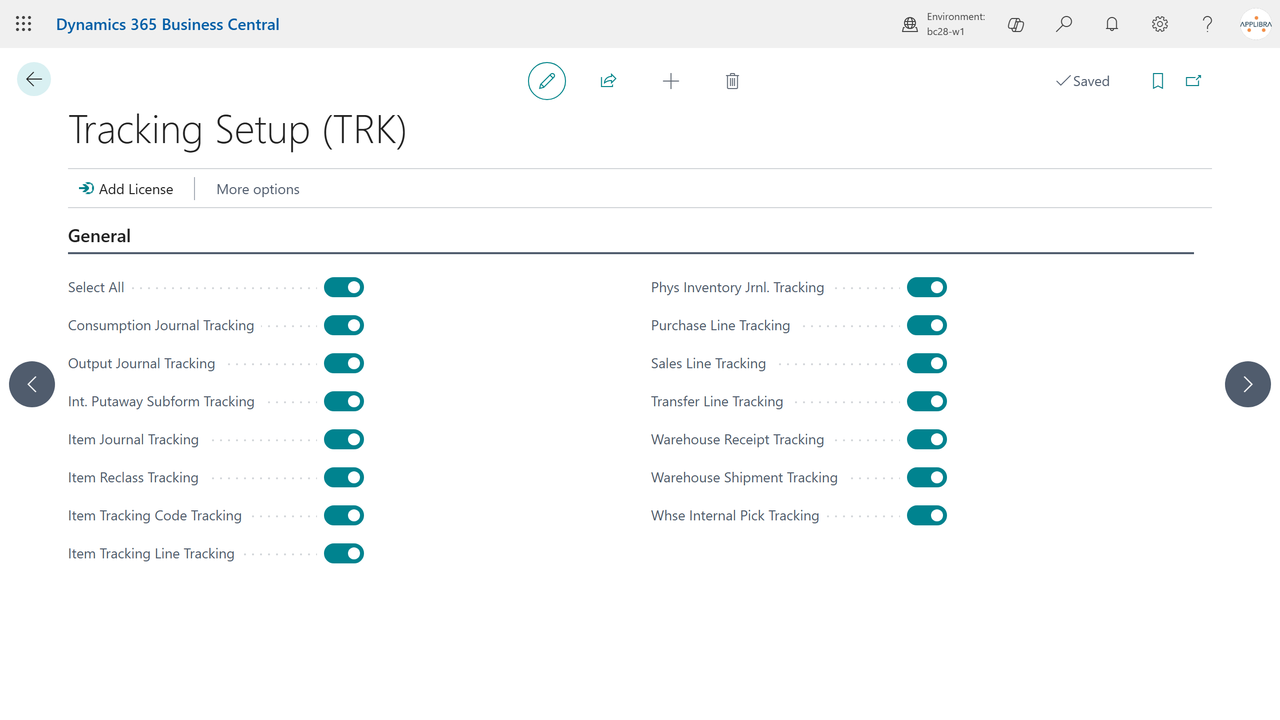
- Tracking is switched on per area in the Tracking Setup: the extra fields and actions appear only on the areas you enable (sales, purchases, transfers, journals, physical inventory, production, warehouse).
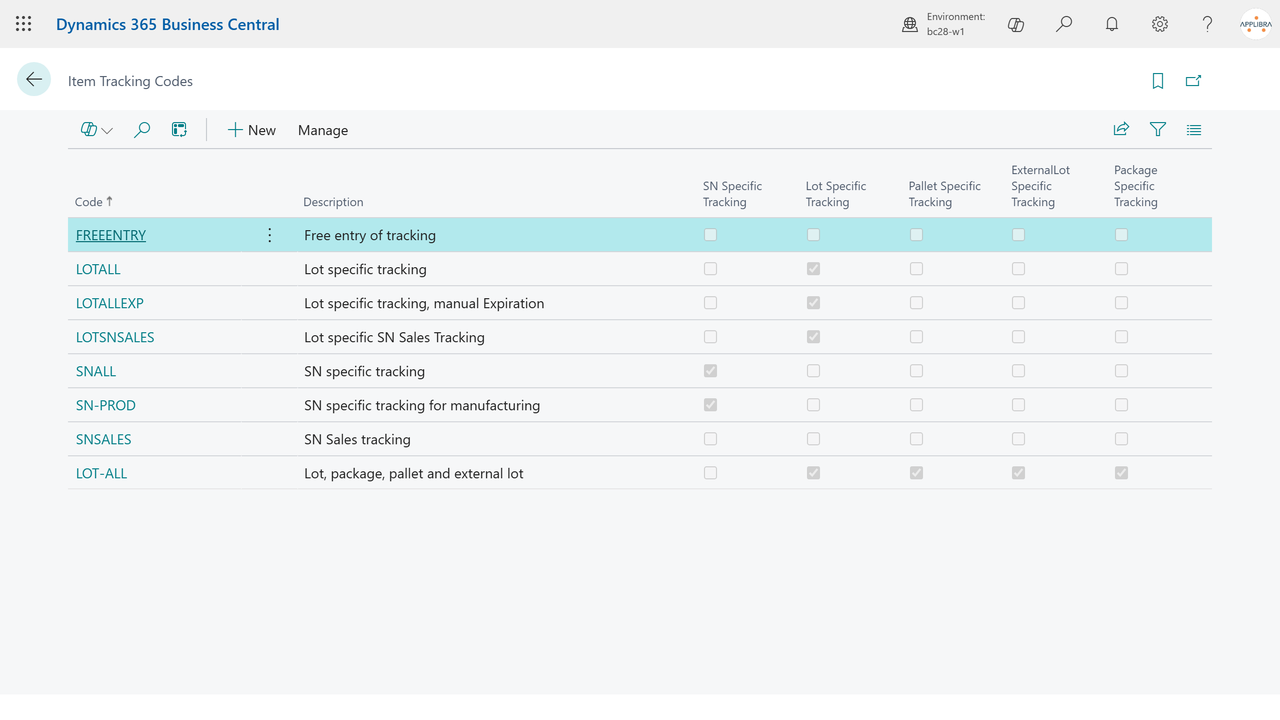
- Which dimensions an item uses is decided by its Item Tracking Code, exactly as for the standard Lot/Serial: the code gains Pallet and ExternalLot sections with the same specific-tracking and per-document requirements.
- On posting, the dimensions flow into the Item Ledger Entries and Warehouse Entries, so stock and history can be filtered and navigated by pallet and external lot as well as by lot and serial.
- Pallet No. Information and ExternalLot No. Information records are the master data of the new dimensions, and are created automatically at posting when missing.
2. Prerequisites
- Business Central 28.0 or higher (Cloud/SaaS).
- The dependencies installed: AL License and Trial Management, AL Message Passing, AL Role Center.
- Permissions: two assignable permission sets. Give ALPTRK-USER (AL Tracking - User) to whoever assigns tracking on documents, journals and warehouse activities: it reads the setup without changing it. Give ALPTRK-ADMIN (AL Tracking - Administrator) to whoever configures the app: it includes the user role and adds the setup and the right to block or delete a pallet or external lot card. A user who opens the Tracking Setup action from the role center without the administrator role gets a permission error, which is the expected behaviour. Both roles include the user role of AL License (ALPLIC-USER), which the license check needs.
- Upgrading from an earlier version: the old permission set of the app (AL TRACKING, or AL ADVANCED LOT up to version 25) disappears with the upgrade. Every user who had it, directly or through a permission set of your own that included it, receives ALPTRK-ADMIN automatically, because the old set granted full access. One case has to be redone by hand: if the old set was among the permission sets given to new users by license (License Configuration page), replace it there with ALPTRK-ADMIN or ALPTRK-USER.
You reach the app from Tell Me: search the page name (for example "Tracking Setup (TRK)") or simply the tag "TRK" to list every page of the app.
3. Setup
3.1 Activate the license
Open Tracking Setup (TRK) (the record is created on first open). Use Add License to enter a license when you have one; a trial is available for evaluation.
3.2 Enable the areas to track
On Tracking Setup (TRK), turn on the areas where the extra dimensions must appear:
- Sales Line Tracking, Purchase Line Tracking, Transfer Line Tracking;
- Item Journal Tracking, Item Reclass Tracking, Phys Inventory Jrnl. Tracking;
- Consumption Journal Tracking, Output Journal Tracking;
- Warehouse Receipt Tracking, Warehouse Shipment Tracking, Whse Internal Pick Tracking, Int. Putaway Subform Tracking;
- Item Tracking Line Tracking (the extended Item Tracking Lines) and Item Tracking Code Tracking (the extended Item Tracking Code card).
Use Select All to enable everything at once. An area that stays off keeps the standard Business Central behavior.
3.3 Configure the Item Tracking Code
Open the Item Tracking Code of the item (with Item Tracking Code Tracking enabled in the setup, the card shows two new sections):
- Pallet Tracking - Pallet Specific Tracking works like the standard lot-specific tracking: on outbound you must state which existing pallet you handle. The Inbound and Outbound groups let you require the pallet number per document type (purchase, sales, positive/negative adjustment, assembly, manufacturing), plus Pallet Warehouse Tracking and Pallet Transfer Tracking. Pallet No. Info. Must Exist requires an information record before posting.
- ExternalLot Tracking - the same set of options for the supplier's external lot: ExternalLot Specific Tracking, per-document requirements, warehouse and transfer tracking, and ExternalLot No. Info. Must Exist.
Assign the tracking code to the items as usual.
Open the code to review the settings per document type: enabling Pallet Specific Tracking switches on the whole pallet section (warehouse, purchase, sales, adjustments, transfer, assembly and manufacturing), and the external lot section behaves the same way.
3.4 Decide how lot numbers are made (Lot Types)
A lot type says how the lot numbers of an item are composed and how far they have to be free. Items inherit it from the item tracking code they already carry, so a tracked item cannot be left without one. Open Lot Types (TRK) and create the types you need:
- Composition - which rule makes the number. Number Series is what Business Central does on its own, and is the default. External Lot No. names the lot after the lot the supplier gave, so the same number is on the delivery note and in your warehouse.
- Lot Nos. - the number series used by Number Series. Left empty, the number series of the item is used, exactly as before.
- Lot No. Uniqueness - None (default) assigns the number as it comes. Item and Variant checks the number is free for that item before assigning it, looking at the lot information, the entries, the tracking of documents not yet posted and the lines still on screen. The check is never made across items: the same number on a semi-finished item and on the finished product made from it is a chain, not a collision.
- Max Composition Attempts - when a number is already used, the rule is asked for another one, and told which attempt this is, so it can tell the two lots apart. After this many attempts the assignment stops with an error instead of assigning a number that is not free.
- ExternalLot No. Suggestion - where the external lot number comes from when the supplier did not give one: Vendor Shipment No., the delivery note number, or Vendor and Shipment No., which puts the vendor in front, because a delivery note number is unique for the vendor who wrote it and not in the world.
On the Item Tracking Code card, Lot Type Code names the type to use. Left empty, lots behave as they do in Business Central and nothing changes.
Two habits worth keeping. Give the lot type the same code as the item tracking code when you want the two to coincide, which is how the old systems worked. Share one lot type between several tracking codes when you want those lots to resemble each other, never to save a line of master data: changing a shared lot type changes the numbering of every class of items that uses it.
About the suggestion, three things it does not do. It only fills an empty external lot, so a number somebody typed is never replaced. It does not replace the check that the external lot is there when the tracking code requires it: if there is nothing to suggest, the posting stops as before. And it never shortens a value to make it fit: if vendor and delivery note number together pass the 50 characters of the field, the assignment stops and says so, because a cut number looks good and no longer leads back to the supplier.
One consequence to know before you choose it: with either suggestion, the Vendor Shipment No. becomes required to post a receipt of those items. A fallback that leans on an empty field is not a fallback, so the setting carries the obligation with it. The delivery note number is usually typed after the goods arrive, when tracking has already been assigned: it is enough to type it on the document, and the external lots left empty are filled then.
4. Daily use
4.1 Item journal and reclassification
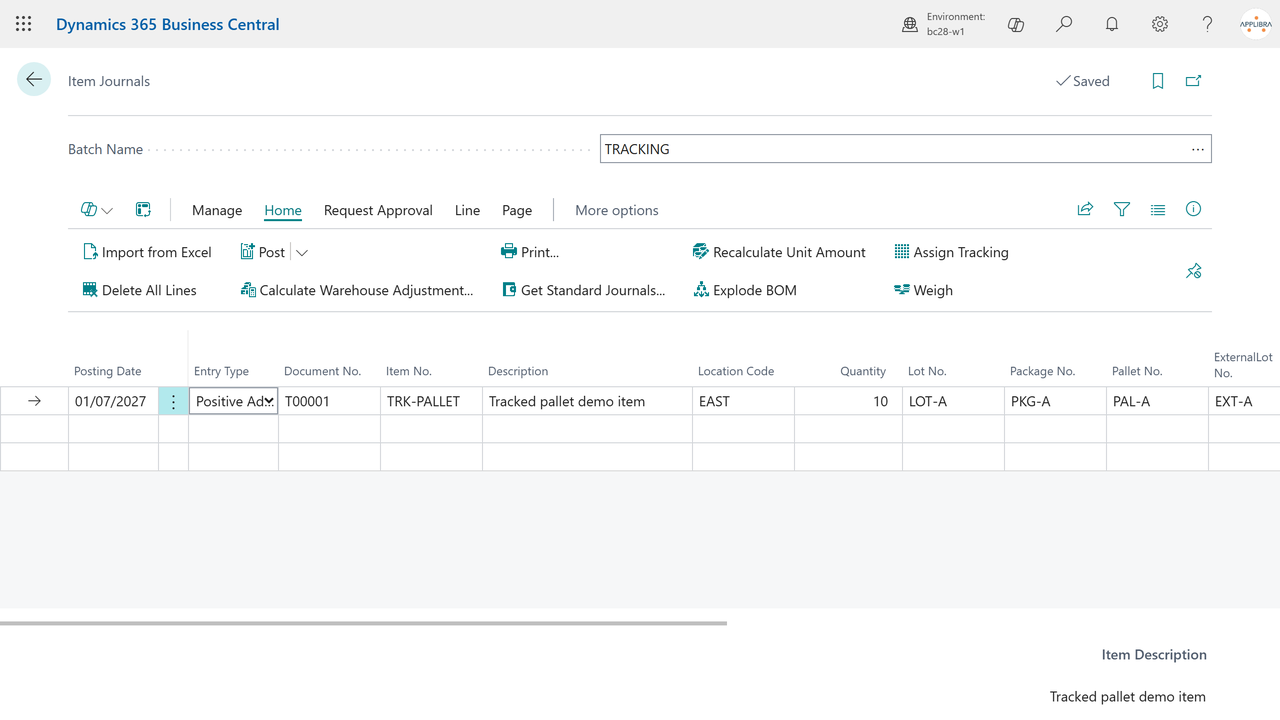
With Item Journal Tracking enabled, the item journal lines show the tracking fields directly on the line: Lot No., Serial No., Package No., Pallet No. and ExternalLot No. (each visible only if at least one tracking code uses that dimension).
- Enter the journal line as usual.
- Fill the tracking fields: type the values, or use the assist button on each field to pick from the existing combinations in inventory.
- Or run Assign Tracking (Functions group) to assign lot, serial, package, pallet and external lot - with expiration date and quantity - in one step.
- Post: the dimensions land in the item ledger entries.
The Item Reclassification Journal works the same way and carries the old and new values, so a reclassification can move quantity from one pallet or external lot to another.
4.2 Physical inventory by traceability
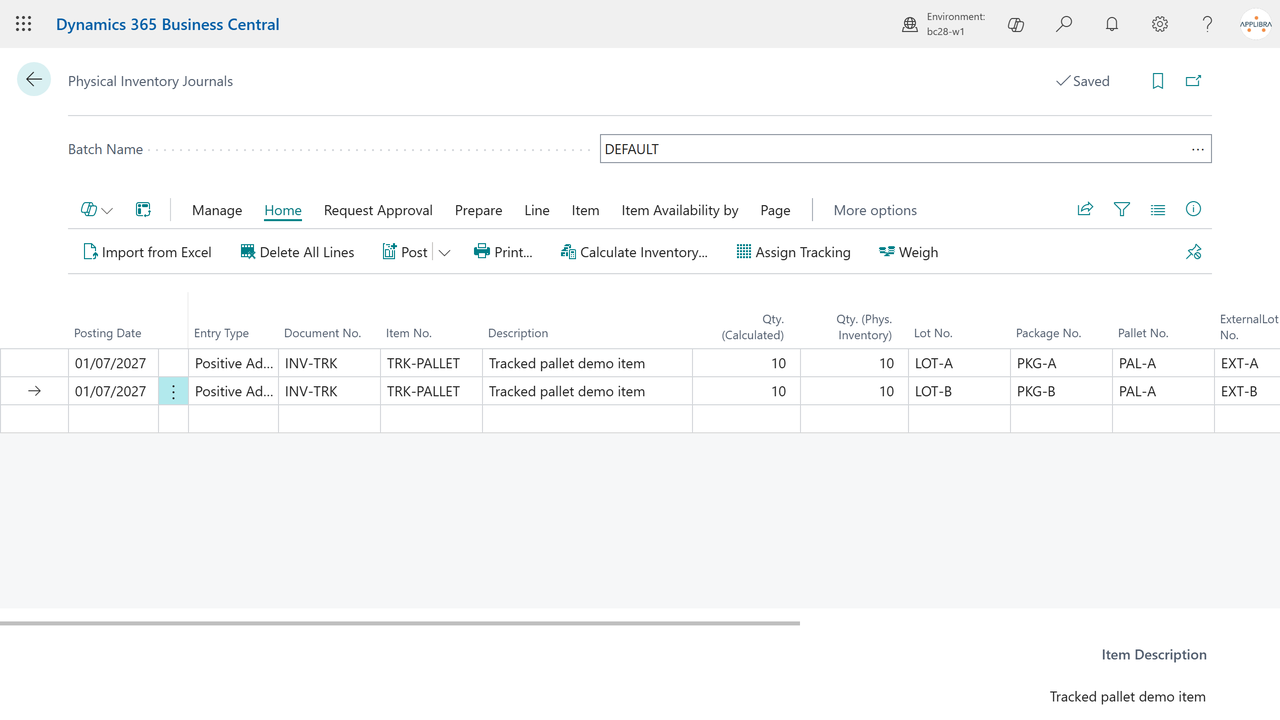
On the Physical Inventory Journal (area Phys Inventory Jrnl. Tracking), the app replaces the standard calculation with Calculate Inventory by Traceability (TRK):
- Run Calculate Inventory (Functions group). The request page accepts the usual filters (Item No., Location, Bin).
- The journal is filled with one line per tracking combination - lot, serial, package, pallet, external lot - instead of one line per item, on both standard and bin-managed locations.
- Count, enter the physical quantities per combination, and use Assign Tracking for the corrections that need new tracking values.
- Post: the differences are written per tracking combination.
The lines are split by the full tracking key, not by a single dimension: the same pallet carrying two different lots produces two lines, so a mixed pallet is counted lot by lot.
4.3 Sales, purchase and transfer lines
With the corresponding areas enabled, the document lines show the tracking dimensions and an assignment action:
- Sales order and Purchase order lines: Assign Tracking assigns the dimensions for the line quantity.
- Transfer order lines: Assign Shipment Lot and Assign Receipt Lot assign the tracking separately for the shipment and the receipt side.
- The assist button on the tracking fields filters the existing combinations for the item, and tracking can also be retrieved from posted shipments, receipts and invoices.
4.4 Consumption and output journals
With Consumption Journal Tracking and Output Journal Tracking enabled, the production journals carry the same tracking fields and the Assign Tracking action:
- Consumption Journal: assign which lot/package/pallet/external lot is consumed by the production order components.
- Output Journal: assign the tracking of the finished output.
- The same fields and actions are available on the Production Journal and the released production order lines.
4.5 Warehouse
The warehouse documents and journals enabled in the setup (receipt, shipment, warehouse journals, internal picks and put-aways) carry the same dimensions, and the extended Item Tracking Lines and Warehouse Item Tracking Lines show the pallet and external lot columns alongside the standard ones.
5. Master data
5.1 Pallet No. Information
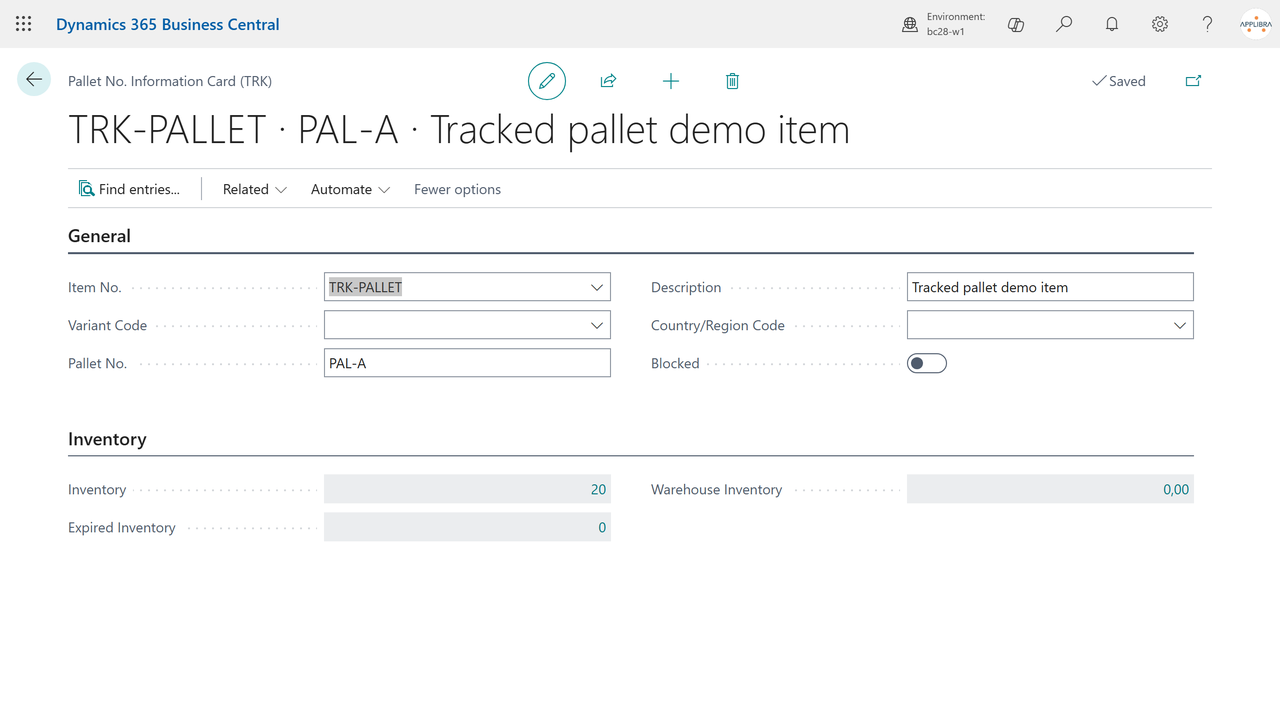
Open Pallet No. Information List (TRK) (Tell Me). Each record identifies one pallet (SSCC) for an item/variant and carries description, country/region, certificate number, a Blocked flag, comments, the expiration date, source information (document, posting date, source type and number) and the calculated Inventory and Expired Inventory - filterable by location and bin, with the warehouse quantity alongside.
5.2 ExternalLot No. Information
ExternalLot No. Information List (TRK) is the same master data for the supplier's external lot: one record per item/variant/external lot, with the same descriptive fields, blocking, comments and calculated inventory.
5.3 Automatic creation
You do not need to create the records by hand: when a journal or document is posted with a pallet or external lot number that has no information record yet, the app creates it automatically. The Must Exist flags on the Item Tracking Code are for the opposite policy: require the record to exist before posting.
6. Where to find it
- Tell Me: search "TRK", or directly "Tracking Setup (TRK)", "Lot Types (TRK)", "Pallet No. Information List (TRK)", "ExternalLot No. Information List (TRK)".
- On documents and journals: the Assign Tracking action (Functions group) on sales and purchase order lines, item/reclassification/physical inventory journals, consumption and output journals, warehouse documents; Assign Shipment Lot and Assign Receipt Lot on transfer order lines; Calculate Inventory on the physical inventory journal.
- Item Tracking Code: the Pallet Tracking and ExternalLot Tracking sections.
7. FAQ and limits
- What exactly is the Pallet No.? The SSCC of the pallet. The field is handled at 20 digits to cover the different pallet types.
- What is the External Lot No.? The lot or carton number assigned by the supplier, kept alongside your internal lot.
- I do not see the tracking fields on a page. The dimensions must be enabled per area in Tracking Setup (TRK), and a field shows only if at least one item tracking code uses that dimension. Check both.
- The Pallet/ExternalLot sections are missing on the Item Tracking Code. Enable Item Tracking Code Tracking in the setup.
- My lot numbers still come from the number series. That is the default. A lot number is made differently only where the item tracking code names a lot type whose composition says so.
- Posting a receipt asks for the Vendor Shipment No. One of the items on the document has a lot type that takes the external lot number from the delivery note, so the delivery note number is required. Type it on the document: the external lots still empty are filled at the same time.
- Do other AppLibra apps use these dimensions? Yes: AL Tracking is the traceability engine of the platform, and apps such as AL GS1 and AL Catch Weight assign tracking through its functions (for example from barcode scanning and weighing) over the AL Message Passing bus.
8. Support and resources
- Publisher: AppLibra - https://applibra.com
- Apps catalog: https://applibra.com/apps
- Privacy policy: https://applibra.com/privacy-policy
- Terms of use: https://applibra.com/terms